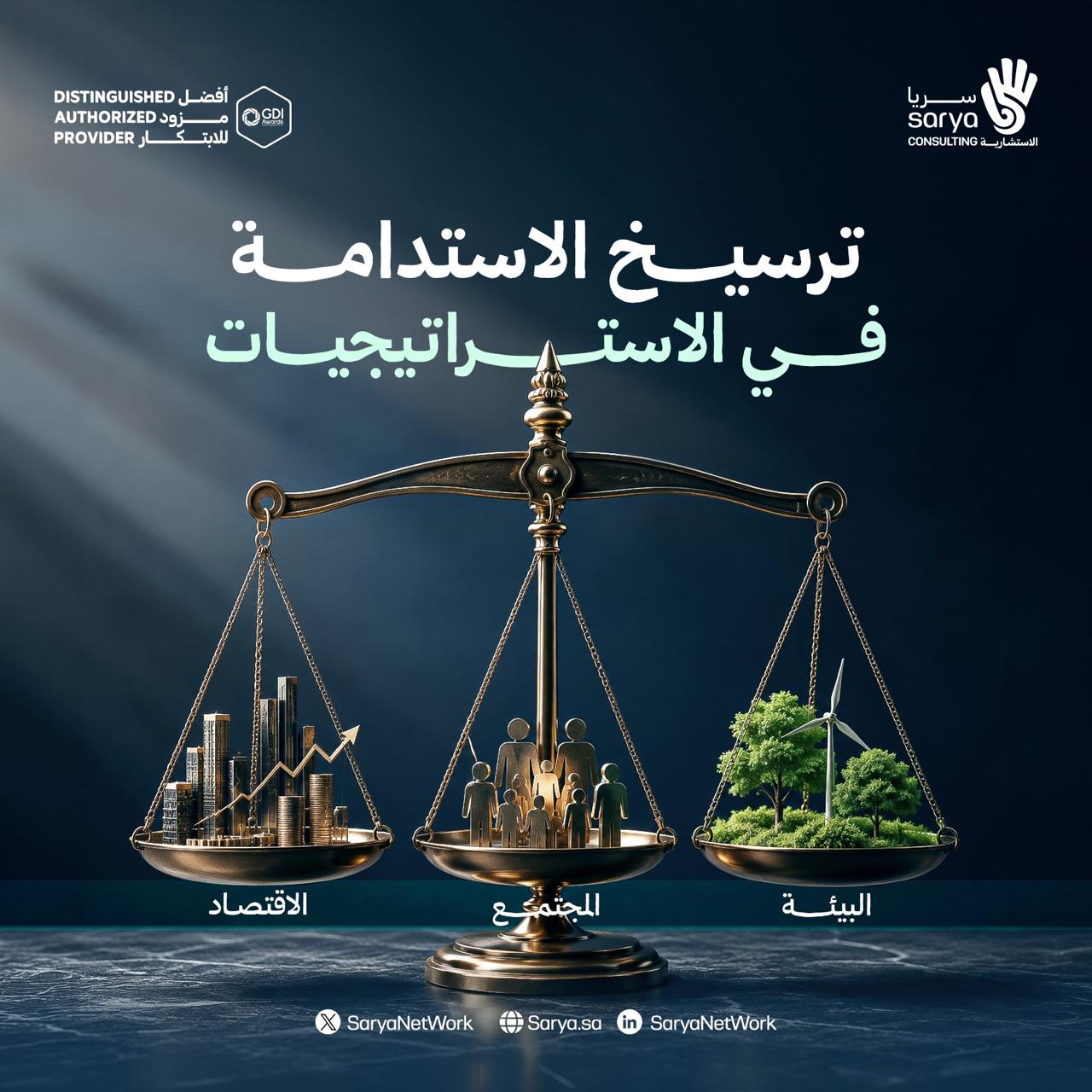
Embedding Sustainability in Strategies: From Isolated Initiatives to a Holistic Mindset
In many organizations, sustainability appears as a set of separate initiatives—environmental reports, social programs, and awareness campaigns.
But the real question that changes the equation is:
Is sustainability part of the strategy, or just an add-on?
Because there is a big difference between an organization that “runs sustainability initiatives” and one that “thinks and operates through a sustainability mindset.”
In light of major transformations such as Saudi Vision 2030, sustainability is no longer an optional complement. It has become a core element in policy design, investment direction, and achieving balance between economic growth, environmental protection, and social development.
Sustainability: From an Environmental Concept to a Strategic Framework
In the past, sustainability was mostly understood as an environmental issue: reducing emissions, saving energy, and protecting resources.
Today, it is much broader. Sustainability means achieving balance between the economy, society, and the environment, meeting present needs without compromising the ability of future generations to meet theirs. It is no longer an activity—it is a way of thinking behind every decision.
Why Sustainability Must Be Integrated into Strategy
Modern challenges are interconnected. Economic growth cannot be achieved without considering environmental impact, services cannot be developed without the social dimension, and long-term planning cannot exist without sustainability.
When sustainability is not part of the strategy, contradictions appear in decisions. But when it is truly embedded, decisions become more balanced and effective.
From Isolated Initiatives to an Integrated System
A common mistake is treating sustainability as separate projects: an energy program, an environmental initiative, and a social activity—without clear connection.
Real transformation happens when sustainability becomes:
part of the vision, embedded in objectives, linked to KPIs, and integrated into execution.
At this point, it shifts from “initiatives” into a strategic system.
How Sustainability Is Actually Integrated
Integration is not done through slogans, but through practical steps:
Embedding sustainability into the vision and mission as part of organizational identity
Translating sustainability into strategic, outcome-based objectives
Defining clear KPIs measuring environmental, social, and economic impact
Integrating sustainability into projects and initiatives, not separate programs only
Linking sustainability to budgets and investments as part of financial decisions
Building monitoring and evaluation systems to ensure results
The Three Dimensions of Sustainability in Organizations
For sustainability to be complete, it must include three dimensions:
Environmental dimension
Resource management, emission reduction, environmental protectionSocial dimension
Quality of life, equity, inclusionEconomic dimension
Cost efficiency, sustainable growth, economic diversification
True sustainability lies in balancing these three dimensions.
The Real Challenge: From Commitment to Implementation
Many organizations declare their commitment to sustainability, but the real challenge is implementation:
Does sustainability influence daily decisions?
Is it included in project evaluation?
Is it measured regularly?
Without this, sustainability remains a theoretical concept.
Data: The Foundation of Smart Sustainability
Sustainability cannot be managed without measurement. That is why modern sustainability relies on:
Data
Indicators
Reporting
Not only to understand the current state, but to improve it. Organizations with accurate data achieve real sustainability.
Sustainability and Innovation: A Complementary Relationship
Sustainability is not a constraint—it is an opportunity for innovation: new solutions, clean technologies, and innovative business models.
Organizations that understand this transform sustainability from a responsibility into a strategic advantage.
The Future: Strategies Designed for Future Generations
We are moving toward a new model where strategies are not only built for today, but for the future. Every decision is evaluated not only by its immediate impact, but by its long-term effect.
Here, sustainability becomes not a separate goal, but a core decision-making standard.
Our Role as a Partner in Embedding Sustainability
We help organizations to:
Design sustainable strategies
Develop sustainability KPIs
Integrate sustainability into initiatives
Build clear governance models
Link sustainability with performance and outcomes